
When it comes to eating in Chinese culture, there are dining etiquette rules to be mindful of.
Chinese table manners hold a lot of importance and are symbolic of Chinese traditions.
Adopting good dining etiquette can help one connect with Chinese family at home. It can also help leave good impressions with Chinese colleagues over formal business meals.

Coming from a Chinese-Malaysian family, Chinese eating customs has been a big part of my life. I’ve always found myself sticking by them.
Here are some common Chinese dining etiquette mannerisms.
Seating arrangement
There is usually an unspoken seating arrangement at the Chinese dining table This arrangement is a marker of hierarchical, honor and patriarchal structures in Chinese families, a reminder of one’s place at home.
Usually respected elders grandpa, grandma or the parents take the most venerable seat at the table, namely the seats facing the door which gives them full view of who comes and goes.
In Chinese culture, elders are deemed wisest and more deserving of respect. To loosely put it, They have earned ‘the best view’ and ‘watching their back’ at the table.
Also, before one starts eating at a Chinese meal it’s customary to wait for everyone to be seated and for someone to invite everyone to tuck in. In Asian cultures, a meal is a chance to recognise the people in our lives. Togetherness, family and guānxì (关系 / connections) are virtues in Asian culture.
‘Sik fan’ (食飯 / Eat rice / Let’s eat) is what my grandma always said to signal the start of extended family dinners. She would then scoop pieces of yellow-skinned chicken (白切雞 / bái qiē jī) for the kids.
Ordering and serving dishes
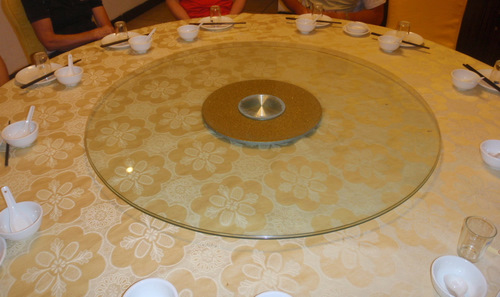
Sharing is a big part of Chinese meals in line with the notion of togetherness. At many Chinese banquets, tables are round as opposed to rectangular. No matter where one sits at a round table, they can see and talk with each other.
The concept of circle (圆 / yuán) is symbolic of unity (团圆, tuán yuán; reunion) and the moon (圆月, yuán yuè / full moon) – two important markers among many Chinese people.
Very rarely is a single Chinese dish eaten by one person all for themselves. Each dish is usually shared or put on a revolving Lazy Susan in the middle of the table. This is helpful for my short arms wanting too reach the dishes on the other side of the table. On a side note, the Lazy Susan’s inventions supposedly has roots in the Western world.
Cutlery and table manners
Chinese table manners are at times tied to Chinese superstitions. More often than dining superstitions are subtle reminders to be thankful for the present and food on the table.
Sticking chopsticks upright in a bowl is frowned upon. It resembles joss sticks at the altar , symbolic of death which is a taboo topic among stereotypical Chinese.
Banging chopsticks together is symbolic of beggars begging for money and being out of work is shameful to many a Chinese family.
Holding one’s rice bowl close to their mouth as they eat is encouraged. That way food won’t fall to the ground. Earning your food through hard work is prided upon in Asian cultures. My mum constantly said to me over dinner as a kid, “Finish your rice”.
Similarly, slurping one’s food or asking for another serving is not rude. It’s seen as showing appreciation for a Chinese meal.

Drinking
As part of many big Chinese meals (think reunion dinners and wedding banquets), it’s customary to toast to the occasion.
When proposing a toast, pick an occasion/event/commemorative memory. Get everyone at the table to stand up and raise their glasses. Lead the toast by shouting ‘yum seng‘ (飲勝 / drink to success).
Everyone will yell the phrase too as they raise their drinks higher in the air. The louder and longer the yum seng, the more auspicious it’s touted to be.
Oddly enough at each extended family dinner, I’m usually the last to stand up for the yum seng toast, last to raise my glass of tea…and as if on cue, everyone else around the table will burst into a deafening chorus of yummm senggg – which can go on for a minute or more like this Chinese dinner.
Finishing the meal
When a Chinese banquet meal ends, there are usually complimentary wet hand wipes given out to clean your hands. It’s respectful to thank the hosts too.
Generally it is not polite to leave without the host or eldest person’s permission. But if you have to leave early, let them know and thank them for the invitation in the first place.
It is also considered polite to offer to pay the bill or offer to shout the hosts a meal another time.
* * *
Chinese dining etiquette is more than just unspoken cultural rules and routine. It begets a sense of selflessness and togetherness. It’s never about oneself all the time but also others around us – making sure everyone has a seat at the table, sharing food and appreciating each other’s presence throughout the meal.
Eating is a daily affair. It can feel mundane if you eat the same dishes with the same people regularly, even if it’s once a year at a certain time of the year. But though you may not feel excited gathering to eat together, your sheer presence at the table does matter.
When you sit down for a meal together, there’s an unspoken agreement to be together and put aside differences for a moment, no matter where you’ve been and what you’ve done. As author Emily Post said about treating others:
‘Manners are a sensitive awareness of the feelings of others. If you have that awareness, you have good manners, no matter what fork you use.’
Each time I look around at the rest of the family shouting yummm senggg at the top of their lungs, my mouth twitches upwards ever so slightly. There’s something special about sharing and being a part of a typical Chinese meal.
It’s uplifting to say the least. And fun. Each time my family drags on the yummm senggg in unwavering rousing unison of a chorus, I hold my glass of tea up a little higher. Always.
Have you eaten Chinese cuisine with Chinese people?


 Mabel Kwong
Leave a reply to Nat Cancel reply