
Some say yes and some say no to a new Australian flag. There are countless arguments for and against this discussion, especially when Australia Day comes around each year and Australians reflect on what our country and flag mean to us.
Our current flag was chosen through a national competition in 1901. 32,823 entries were submitted and a panel of judges declared five entrants who presented similar designs as the winners. That was a while ago. As someone who is lucky to live in an Australia in a time where there are world class facilities and a multicultural population, sometimes I wonder: does our current flag truly represent Australia today?
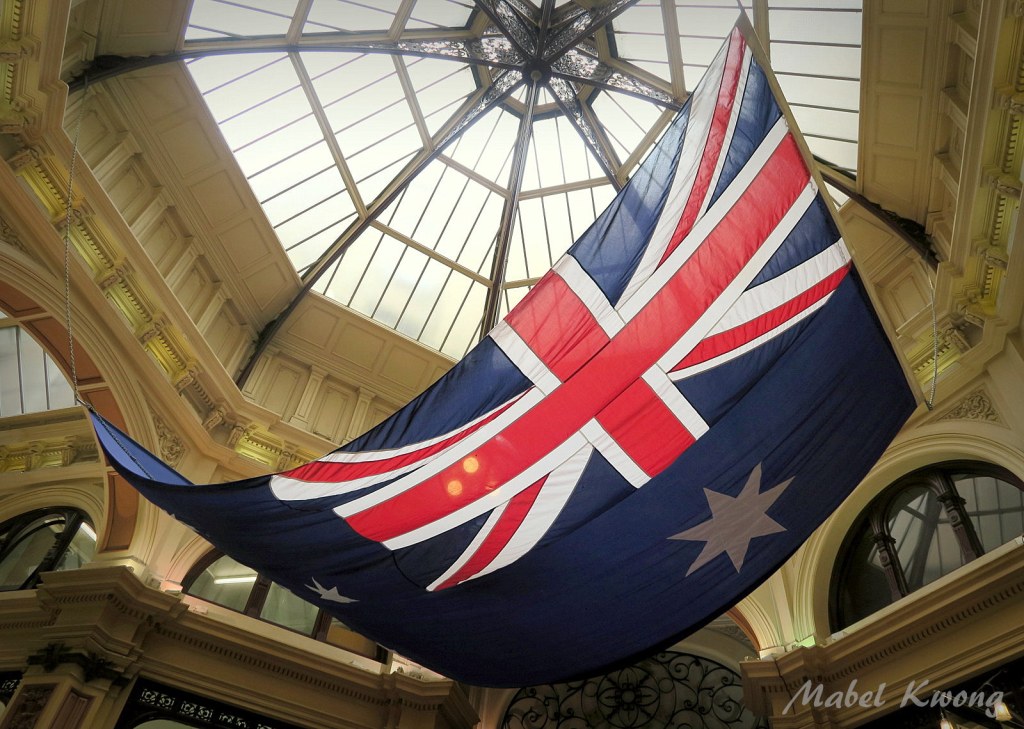
There is a blue ensign and red ensign; under the Flags Act 1953 the former was officially chosen as our national emblem. The symbolic elements making up the Australian flag are the:
- Union Jack (top left): acknowledges British settlement from 1788-1850
- Commonwealth / Federation Star (bottom left): its seven points represent the unity of our states and territories
- Southern Cross (right): a constellation that can only be seen in the southern hemisphere, a reminder of Australia’s geography
Some say Australia needs a new flag because the current one does not wholly represent the values and progressive identities of our country in recent times. Australia has evolved as a nation since the end of British colonial era, and those who defended Australia during times of conflict did so not for a flag, but for a country. Today, we are an independent country governed by a democratically elected government and migrants are a significant makeup of the population – so the relevance of the Union Jack today is questionable.
This is exactly the sentiments of my blonde haired Australian colleague, Simone, many years ago. One day, someone propped a mini Australian flag in my stuffed monkey Mr Wobbles’ hands. Simone saw this scene and exclaimed, “I don’t understand why he has to be so patriotic! I hate it!” According to her, not all cultures of which want to be paraded under the Union Jack.

The symbolism of the Australian flag is arguably lost on us today. A flag is a marker of who we are, who and what we stand for. Consequently, Australia needs a flag with distinctive symbols that we identify with as a nation. The kangaroo, boomerang, koala, golden wattle, emu and opal are just a few proudly recognised icons by many as uniquely Aussie and featured during numerous national and international political, entertainment and sporting events. In addition, Canada did away with the Union Jack on their flag in 1965 and New Zealand are in the process of holding referendums to decide if it will replace their flag.
A flag that we proudly raise and wave is a flag that we believe in. Perhaps it’s time Australia had a flag which is symbolic of where we are going, recognising its First Peoples, Indigenous Australians and multicultural communities moving forwards as a nation. A recent poll shows more than half of Australians support a republic. A change of flag colours is seemingly apt in order to encourage equality and national unity as we move away from being a constitutional monarchy: the current colours and elements of the flag are reminiscent of a bygone era, disregarding the stolen generation and rightful owners of Australian land.
However, there are reasons to stick with the current flag. The Union Jack signifies a significant moment in Australia’s history; we would not be where we are today if not for the past. Everyday Australians designed the current flag; fair say, fair go, as can be said. But apart from the fact that that was decades ago, national identity is constantly changing.

It is worth wondering about the degree of respect that we have for national flags. While in high school in Singapore, my class attended compulsory assemblies every morning and watched the Singapore flag being raised as the national anthem played. In the month leading up to the city’s national day, locals are encouraged to display the country’s flag outside their homes and businesses. In Singapore, the national flag is treated with utmost pride, not something to be paraded about casually.
In contrast growing up in Australia, I didn’t see the Australian flag much at school except during weekly or monthly assemblies. Come Australia Day, many of us drape the flag over our shoulders as we celebrate the day with BBQs and wear flip-flops, shorts and bikinis decorated with the flag design on them – a more colloquial fashion of expressing reverence towards a flag.
In a sense, Australia’s current flag is associated with racism. Aside from disregarding the First Peoples, our flag is often used as a barrier or shield against another race: for instance, protestors at the Reclaim Australia rallies wore homemade flag masks, clashing with fellow Australians. Also, while the Aboriginal flag and Torres Strait Islander flag are official flags of Australia, they are raised seconded to the national flag. Then there is also the Boxing Kangaroo flag, often waved around at sporting events we participate in. Different flags for different occasions in Australia.
There are other ways to show patriotism, love and respect for a country instead of through a flag. Voting, don’t do crime and volunteering in the community are a few examples. But expressing patriotism through a flag and standing united (waving the flag together, watching it being raised) for our country is something special: that’s when we put our differences aside. As Barack Obama said:
“In the face of impossible odds, people who love (a) country can change it.”
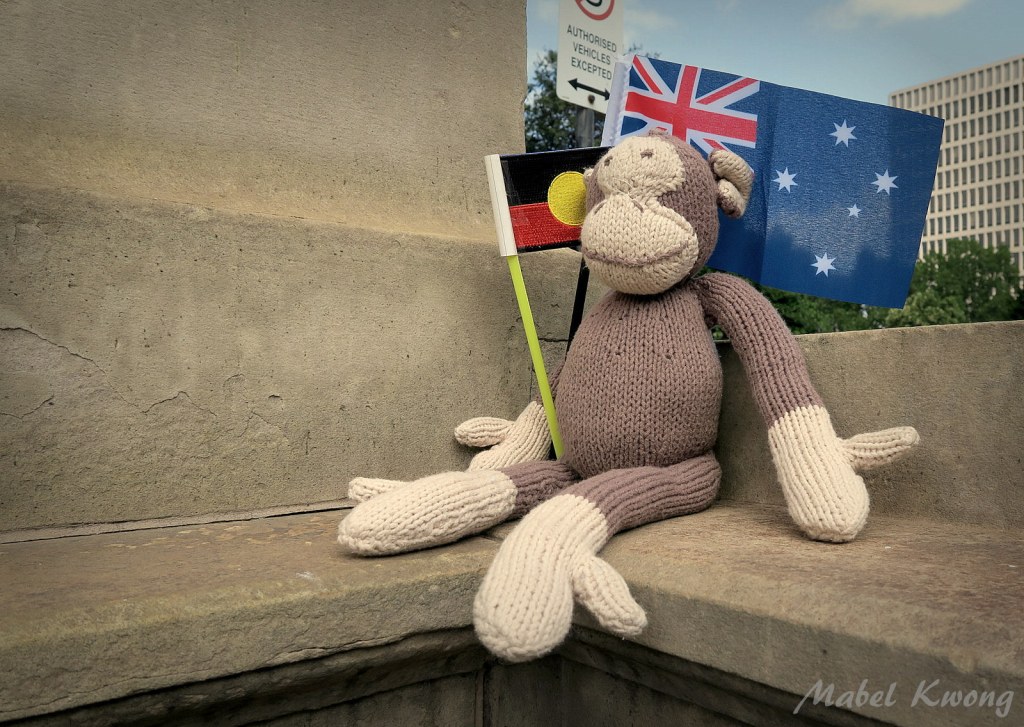
A few days after Simone’s outburst, I put Mr Wobbles on her desk with the mini Aussie flag in his hands. Went back to my work. Some hours later I walked by and saw the flag gone, no where to be seen. Simone must have had a fit and ripped it away from the monkey. Mr Wobbles looked crestfallen but I don’t blame my colleague.
Each of us Australians, no matter where we are from, need to know better the flags we wave. Designing a new Australian flag is a whole other discussion. It’s time we get started on that.
Are you proud of your country’s flag?


 “they are not patriotic about the country, only about the team” That has never crossed my mind. I think a lot of us make that assumption when we see fans waving their countries flag. Now that you mention this, I suppose waving a flag does not necessarily mean we are loyal and proud of our country…


 Mabel Kwong
Leave a reply to Constance – Foreign Sanctuary Cancel reply