
If you haven’t been living under a rock these past couple of months, you probably would’ve heard of Psy and watched the viral music video that has racked up over 500 million views and counting for his hit song Gangnam Style.
You might have also noticed the more than generous media coverage Psy and his ‘horsey-dance’ have been attracting.
With Psy hitting the headlines in Australian mainstream news of late for his satirical tune that pokes fun at the lavish lifestyles of South Korea’s Gangnam district and his signature dance proving a hit with locals, one can say Koreans (Asians) are finally receiving much deserved representation in Australian media and that multiculturalism is well and truly alive Down Under.
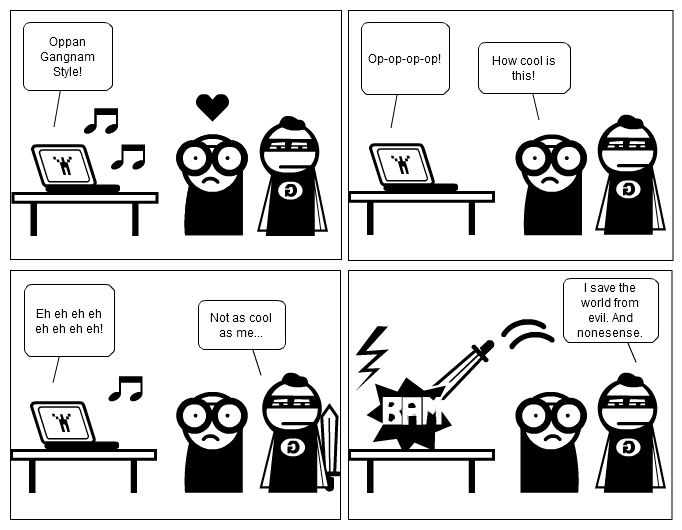
However, many media companies are essentially profit-driven businesses buoyed by advertisers and it is exactly this reason that we should question whether the media genuinely advocates for a diverse society through Gangnam Style – and leading us who are passive media audiences to believe that Asian music/culture is really making its mark in the ‘multicultural’ Western world.
The programs we watch on television and stories that we read in the papers are often deliberately constructed from ‘newsworthy’ angles so as to potentially attract the maximum number of eyeballs, all for the benefit of advertisers. This is done through “media framing”, which Entman explains:
“To frame is to select some aspects of a perceived reality and make them more salient in a communicating text in such a way as to promote a particular problem definition, causal interpretation, moral evaluation, and/or treatment recommendations.”
Stories with a focus on ‘celebrity personas’ are frequently regarded as newsworthy. Multi-talented Korean performer Psy is regularly illustrated in Australian (online mainstream) media as a celebrity figure vainly trying to reach the highest highs of stardom, supporting the values of capitalist society instead of the principles of a multicultural community.
The frames used in reporting the Psy phenomenon distances Australians from seriously engaging with Korean culture, simply seeking to entertain. Broken down below, they neither encourage us to appreciate ethnic cultures nor understand the importance of Asian cultures in today’s society.
The Frames
1. ‘Us’ and ‘Them’
It is hard not to miss how Psy is endearingly branded as an untouchable celebrity figure in Australian media, distracting us from learning and exploring the creative processes within the Korean pop music industry, never mind the fact that it is a cookie-cutter business industry.
The phrases “unlikely star” and “unlikely world phenomenon” [1], [2] have been repeatedly used to describe the entertainer alongside ample mentions of “horse(y)-dance” [2], [3]. Ironically, there are also descriptions of Psy as an average Joe who works hard at his craft [3], [4].
Bits and pieces of Psy’s personal life have also been fleshed out with little mention of other Korean entertainers [5], pumping up Psy’s celebrity status while diminishing the Korean music scene to one Korean individual performer.
And to pretty much one song. And a funky dance.
Admittedly, we are interpolated to focus on the awkward dance and the personality borne out of this Gangnam Style craze instead of discovering how the Korean entertainment industry operates and its significance in today’s globalised era.
And appreciating other genres of Korean music for that matter.
Together, the above descriptions literally iterate Psy is special, one of ‘them’ – an ordinary person of Asian descent who unexpectedly becomes a superstar, kookily transcending the Western entertainment sphere. The underlying message is:
Here is someone out of the ordinary, not like ‘Us’ and our mundane everyday lives, so let’s take a look at this person (‘them’) just because he looks crazy and needs attention. And just look at him.
And we usually end up paying attention to such bizarre shenanigans – they are something we can giggle at for a split second amidst our monotonous, routine day-to-day lives.
2. Stereotypical Conformation
The plentiful coverage about Psy’s mediocre looks, outlandish dress sense and wacky horse dance in mainstream media plays up the stereotypical belief that Asians are the ‘weaker race’, lagging behind Western civilisation in terms of manners, fashion, et cetera.
It has been written that Psy is neither blessed with “brooding good looks” nor the “lithe athleticism” of most K-pop stars [4]. He is often photographed decked out in eccentric floro coloured outfits [2], [5], which along with his comical dance seemingly is enough to make him, or any other person, the laughing stock of any class.
Psy has also been boldly described as a “so-far one hit wonder” [6], enforcing the idea that his dominance on the (Western) charts will be fleeting.
These constructions paint Psy as someone who is aloof, someone who is non-threatening to those watching him. It no surprise local media tend to reinforce long-held stereotypes of ethnic minorities as the inferior race. For the (presumably) predominantly Anglo-Aussie public watching Psy in the media: it is rather nice to watch someone who does not pose a social, economic or racial menace to us; we can sit back and enjoy the show knowing the uneven status quo which is in our favour stays the same.
3. Competition
Psy is somewhat pitted in a so-called competition against Western artists to see who is able to sell the most records possible on a number of occasions. This sort of framing encapsulates the ideas of monetary greed and chasing corporate aspirations in a consumerist society, both of which are divergent from the typical multicultural values of equality and sharing.
For instance, there have been plentiful mentions along the lines of “Gangnam Style sold 65,330 copies…to remain at No.1”, “Can Psy catch the Biebmeister?” and “Psy’s Gangnam Style gallops to No. 1” [7], [8], [9], playing up rivalry vibes.
Other mentions include “(Channel Seven) outbid rival Nine to lure the (entertainer)” and Psy charges “a whopping $60,000” per gig [1].
These racing-esque storylines suggest that the artist who fundamentally makes the most sales or monetary capital reigns supreme in the Western music industry in a capitalist world.
The focus is not on Psy as an outgoing Asian performer who works tirelessly to bring a part of Korean culture to the Western corners of the world, but on Psy as a money-making machine.
However, a competitive media storyline normally grabs attention. After all, who doesn’t like a good race or a dirty competition? It’s always exciting to see who comes out on top, isn’t it?
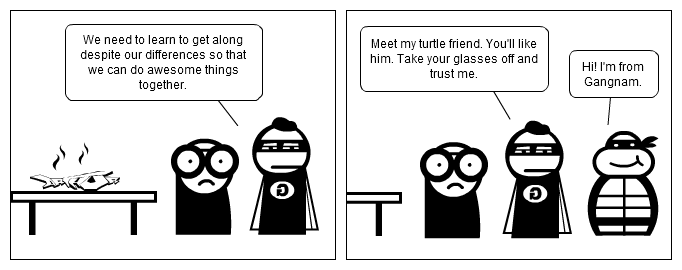
In short, the representation of Psy and the Gangnam Style phenomenon in Australian media appears to be entrenched in the ethos of celebrity fanfare and commodification. The public are enlightened to think about Korean music, or even the topic of ‘Korean’ in general, as simply something to unwind to or laugh at.
There are positives to arise out of the ample media attention Gangnam Style is garnering. For one, there are comprehensive attempts to introduce the Korean pop music industry and culture and the South Korean city of Gangnam to locals who may have never heard of them through the media [10]. Korean food and different methods of Korean cooking have also been featured [11].
However, multiculturalism is not simply just about ethnic songs or the exotic foods that we eat. Multiculturalism is also about people – namely the (harmonious) interactions between people of different ethnicities.
Through the media coverage of Psy and Gangnam Style, we are neither urged to ponder about establishing social or cultural relations with them, nor ponder these insightful questions:
- How can we work/collaborate with our everyday fellow Korean musicians – and colleagues or politicians or friends in general – more efficiently?
- What is it like working with, talking and learning from people of Korean background; can we learn to see issues from fresh cultural perspectives?
- Do we have similarities and/or differences, and do they help or hinder us in getting along with Koreans and other races?
Fitria Mayasari, lecturer at Universitas Pelita Harapan in Indonesia, builds upon cultural theorist Adorno’s idea of pop music as merely a product and sums up how pop music – Gangnam Style for instance – is little more than just entertainment:
“The lack of authentic culture inherent in popular music gives a simulated escape from reality, satisfying listeners without providing genuine solutions to their life’s problems.”
I’ve only watched the Gangnam Style video once and have absolutely no incentive to watch it again. Personally, I believe once we’ve seen it one too many times, I’m sure we’ll be turning our attention to the next craze, and this whole phenomenon would be nothing but akin to a flash in the pan like the many fads before it.
I reckon there are more important things that we can do than rocking out to a hit Asian song and a funky dance for a few weeks.
As per my thoughts above, given that the Psy phenomenon has ignited our interest in Korean culture, it would be worthwhile if we took the effort and explored the different aspects of the culture just a little bit more.
That way, we can cloud our heads with potentially useful knowledge that can inevitably assist us in understanding ethnic cultures and getting along with our friends of different races for a whole lifetime.
Media articles cited:
[1] http://www.dailytelegraph.com.au/entertainment/sydney-confidential/psy-has-his-own-attraction-gangnam-style-star-down-under/story-e6frewz0-1226496593649
[2] http://www.dailytelegraph.com.au/entertainment/sydney-confidential/korean-rapper-psy-does-it-in-style/story-e6frewz0-1226489805963
[3] http://www.theage.com.au/entertainment/music/wild-ride-for-horsey-dancer-20121016-27ow3.html#ixzz29SJZt2qq
[4] http://www.canberratimes.com.au/entertainment/music/gangnam-style–a-reflection-on-the-philosophy-of-horsey-dance-20121012-27i8r.html
[5] http://www.news.com.au/news/gangnam-styles-psy-is-on-his-way-to-australia/story-fnejlvvj-1226496347120
[6] http://www.dailytelegraph.com.au/entertainment/sydney-confidential/psy-has-his-own-attraction-gangnam-style-star-down-under/story-e6frewz0-1226496593649
[7] http://www.heraldsun.com.au/entertainment/music/gangnam-style-beats-out-one-direction-in-australian-music-chart/story-e6frf9hf-1226490602781
[8] http://www.news.com.au/news/is-gangnam-style-going-to-break-the-internet/story-fnejlvvj-1226485831716
[9] http://www.heraldsun.com.au/news/breaking-news/psys-gangnam-style-gallops-to-no1/story-e6frf7kf-1226485995298
[10] http://www.heraldsun.com.au/entertainment/music/postcards-from-gangnam-where-it-all-started-for-k-pop-sensation-psy/story-e6frf9hf-1226496655466
[11] http://www.heraldsun.com.au/news/national/first-it-was-gangnam-style-now-korean-food-is-tipped-to-be-the-next-big-thing/story-fndo48ca-1226499653836


 Mabel Kwong
Share your thoughts. Join the discussion